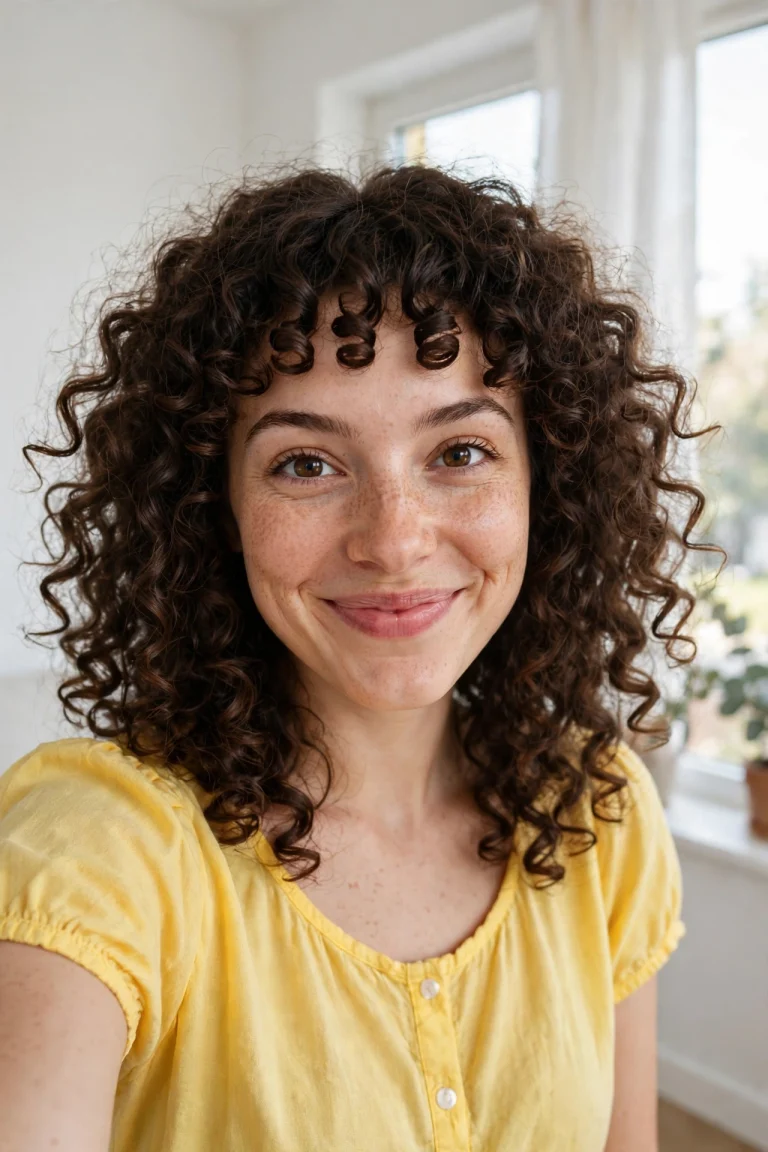
30 Curly Bangs Ideas for Thick Hair With Control

Thick curly hair gives bangs wonderful fullness, but it also needs smart control so the fringe stays shaped, balanced, and comfortable. Control here does not mean flattening your curls; it means managing weight, density, and frizz so the bangs work with the rest of your hair. These ideas cover techniques, updos, routines, and cuts that keep thick curly bangs looking polished without losing their natural bounce.
1. Weight Balanced Curly Bangs for Thick Hair
Weight balanced bangs distribute thick hair evenly across the forehead, so no single section feels heavy or pulls forward. The balance comes from careful sectioning during the cut, not from thinning the fringe away. This even distribution keeps the bangs comfortable all day, even on very thick hair.
2. Sectioned Control Curly Bangs for Thick Hair
Sectioned control means styling the fringe in small, separate sections rather than all at once, which is essential for thick hair. Each section gets product and shaping individually, so nothing is missed or overloaded. The result is a fringe that looks uniform and controlled from every angle.
3. Density Managed Curly Bangs for Thick Hair
Density managed bangs keep the right amount of hair in the fringe: full enough to look intentional, but not so dense that it becomes a heavy block. Your stylist can adjust density during the cut by removing weight from inside the fringe. This management makes thick bangs far easier to style daily.
4. Bulk Softened Curly Bangs for Thick Hair
Bulk softened bangs feel lighter and more flexible, even though the hair itself remains thick. Softening comes from shaping the ends and encouraging the curls to move, rather than cutting the fringe very short. The fringe keeps its fullness while feeling much less bulky on the forehead.
5. Controlled Volume Curly Bangs for Thick Hair
Controlled volume gives thick curly bangs presence without letting them expand into an unmanageable shape. Volume is directed upward and outward in a planned way, with the sides kept tidy. A light hold product helps the controlled shape last through humidity and movement.

6. Calmed Top Curly Bangs for Thick Hair
A calmed top means the hair at the crown is smoothed and settled, so the bangs below it look neat and deliberate. This is especially helpful for thick hair, where crown puffiness can make the fringe look messy. Smooth the crown gently while the hair is damp, leaving the fringe curls free.
7. Frizz Controlled Curly Bangs for Thick Hair
Frizz controlled bangs use moisture and a light sealing product to keep thick curls smooth at the edges. The curls themselves stay bouncy, but the halo of frizz around them is calmed. This approach works well in humid weather, when thick hair is most prone to frizz.
8. Humidity Resistant Curly Bangs for Thick Hair
Humidity resistant bangs are styled with products and techniques that hold up when the air is damp. A humidity-resistant cream or gel forms a light barrier around each curl, preventing it from swelling. This is a practical choice for thick hair in summer or in humid climates.
9. Flexible Hold Controlled Curly Bangs for Thick Hair
Flexible hold products keep thick curly bangs in shape while still allowing them to move and bounce naturally. Unlike stiff gels, flexible hold does not make the fringe crunchy or rigid. The curls stay touchable, which is ideal for everyday thick-hair styling.
10. Plopped Curly Bangs for Thick Hair Control
Plopping involves wrapping damp curly hair in a soft cloth to encourage curl formation and remove excess water without frizz. For thick hair, plopping the fringe section helps it dry in a controlled, defined shape. Leave the wrap on for twenty minutes, then let the fringe finish drying naturally.

11. Hood Dryer Controlled Bangs for Thick Hair
A hood dryer dries thick curly bangs evenly with gentle, indirect heat, which helps control their shape. The even airflow prevents some curls from drying frizzy while others stay damp. Sit under the dryer until the fringe is mostly dry, then finish with a quick finger reshape.
12. Pineapple Updo with Controlled Curly Bangs for Thick Hair
A pineapple updo gathers thick hair loosely on top of the head for sleeping or for a casual style, while the bangs stay controlled at the front. The loose gathering protects the curls from friction and flattening. In the morning, the bangs can be refreshed quickly while the rest of the hair falls back into place.
13. Night Wrap Controlled Bangs for Thick Hair
A night wrap, using a soft scarf or bonnet, protects thick curly bangs overnight so they keep their controlled shape. The wrap reduces friction against the pillow, which is a major cause of morning frizz. Unwrap gently in the morning and reshape the curls with your fingers.
14. Thick Hair with a Controlled Low Bun and Curly Bangs
A controlled low bun gathers thick hair neatly at the nape, while curly bangs keep the front soft and textured. The low position balances the weight of thick hair and prevents neck strain. Secure the bun with pins rather than a tight tie to avoid pulling the fringe.
15. Thick Hair with a Wrapped Bun and Curly Bangs
A wrapped bun twists thick hair around itself into a neat, secure shape, with curly bangs left free at the front. The wrapping technique distributes thick hair evenly, so the bun does not feel lopsided. This is an elegant, controlled option for work or formal events.

16. Thick Hair with a Secure Ponytail and Curly Bangs
A secure ponytail holds thick hair firmly without slipping, while curly bangs soften the face. Use a strong, snag-free tie and wrap a section of hair around the base for a tidy finish. The secure hold means the ponytail stays put even with the weight of thick hair.
17. Thick Hair with a Controlled Claw Clip Updo and Curly Bangs
A claw clip updo twists thick hair up and clips it securely, leaving curly bangs free to frame the face. The clip holds even very thick hair, and the updo can be adjusted easily during the day. Choose a large, sturdy clip designed for thick hair for the best hold.
18. Thick Hair with Barrettes Hold and Curly Bangs
Barrettes can hold back sections of thick hair on either side of the fringe, giving control without a full updo. The barrettes keep the sides tidy while the bangs stay the focus at the front. Use strong barrettes that grip thick hair well, placing them behind the fringe line.
19. Thick Hair with a Controlled Side Knot and Curly Bangs
A knot tied low at one side of the nape gathers thick hair into a controlled, elegant shape, with curly bangs at the front. The knot distributes weight to one side, which can feel more comfortable than a centred bun for very thick hair. Secure it with pins for a neat finish.
20. Thick Hair with a Controlled French Roll and Curly Bangs
A French roll folds thick hair vertically into a classic, secure shape, while curly bangs add softness at the front. The roll contains thick hair beautifully and looks polished for formal occasions. Pin the roll firmly along its length so it holds through the event.

21. Thick Hair with a Controlled Chignon and Curly Bangs
A chignon, a low, twisted bun at the nape, is a timeless way to control thick hair while curly bangs keep the look soft. The chignon can be neat or slightly loose, depending on the occasion. It pairs especially well with defined, controlled fringe curls.
22. Thick Hair with a Controlled Mid Length Cut and Curly Bangs
A mid length cut, falling around the shoulders, gives thick hair a manageable shape that works well with controlled curly bangs. The mid length is long enough to show off curls, yet short enough to avoid excessive weight. Regular trims keep the mid length shape tidy.
23. Moisture Locked Controlled Bangs for Thick Hair
Moisture locked bangs use a leave-in conditioner sealed with a light cream to keep thick curls hydrated and controlled. Well-moisturised curls are less frizzy and hold their shape better than dry curls. Apply the products to damp hair, focusing on the fringe section first.
24. Protein Balanced Controlled Bangs for Thick Hair
Protein balanced bangs benefit from occasional protein treatments that strengthen thick curls and help them hold their pattern. Stronger curls are less likely to go limp or frizzy during the day. Use protein treatments sparingly, balancing them with moisture, to avoid stiffness.
25. Gel Cast Controlled Bangs for Thick Hair
A gel cast forms when gel dries around thick curls, holding them in a controlled shape until the cast is gently scrunched out. Once scrunched, the curls stay defined and controlled but feel soft and touchable. This technique is excellent for thick hair that needs extra hold.
26. Thick Hair with a Controlled Razor Cut and Curly Bangs
A razor cut uses a razor tool to shape thick hair with soft, tapered ends that reduce bulk in a controlled way. The razor creates movement and lightness, which helps curly bangs sit better on thick hair. This cut should only be done by a stylist experienced with razors and curly hair.
27. Thick Hair with a Controlled Point Cut and Curly Bangs
A point cut snips into the ends of thick hair at an angle, removing weight in small, controlled amounts. The pointed ends give curly bangs a softer, more flexible edge. This technique is ideal for thick hair that feels too blunt or heavy at the fringe.
28. Thick Hair with a Controlled Slide Cut and Curly Bangs
A slide cut glides scissors down sections of thick hair to remove internal weight without changing the overall length much. The result is lighter, more manageable bangs that still look full. Slide cutting is a precise technique best left to an experienced curly hair stylist.
29. Thick Hair with a Controlled Dry Cut and Curly Bangs
A dry cut shapes thick curly bangs while the hair is dry, so the stylist can see exactly how each curl falls and how much weight to remove. Dry cutting gives the most accurate control for thick, curly textures. It also avoids the surprise of shrinkage after a wet cut.
30. Thick Hair with a Controlled Wet Cut and Curly Bangs
A wet cut shapes thick curly bangs while the hair is wet and stretched, allowing the stylist to create a precise, even baseline. The stylist must allow generously for shrinkage, as the curls will spring up considerably when dry. When done well, a wet cut gives a clean, controlled foundation for thick bangs.
Styling Tips
- Style thick curly bangs in sections, so every part of the fringe gets product and attention.
- Use a leave-in conditioner first, then a cream or gel, to lock in moisture and control frizz on thick hair.
- Dry thick bangs with gentle, even airflow, and avoid rough towel-drying that creates frizz.
- Protect thick curly bangs at night with a soft wrap, bonnet, or satin pillowcase.
- Refresh thick bangs with a water mist and a small amount of product, rather than washing the whole head.
- Choose strong, thick-hair-friendly accessories, such as large clips and sturdy ties, for updos.
- Trim thick curly bangs regularly, as weight builds up quickly and can change the fringe shape.
Frequently Asked Questions
How do I control thick curly bangs without flattening them? Control comes from managing weight and frizz, not from pressing the curls flat. Sectioned styling, moisture-locking products, and weight-removing cuts all help thick bangs stay shaped while keeping their bounce. A flexible hold product is better than a stiff one for this balance.
Should thick curly bangs be thinned out? Thinning can help, but it should be done carefully and from inside the fringe, not by cutting the top layer short. A skilled stylist can remove internal weight while keeping the fringe looking full. Over-thinning can make thick bangs look wispy and uneven, so discuss density with your stylist first.
What products work best for thick curly bangs? A leave-in conditioner, a curl cream, and a flexible hold gel or mousse usually work well together for thick hair. The leave-in provides moisture, the cream defines, and the gel or mousse holds the shape. Avoid very heavy oils on the fringe, as they can make thick bangs look greasy.
Can I wear thick curly bangs up without them getting messy? Yes, secure updos such as wrapped buns, chignons, and claw clip styles hold thick hair well while leaving the bangs free. The key is securing the updo firmly without pulling the fringe tight. A quick fringe refresh after styling the updo keeps the front tidy.
How often should thick curly bangs be cut? Most thick curly bangs benefit from a trim every six to eight weeks, as weight and growth change their shape. Because thick hair grows out with extra bulk, regular light trims prevent the fringe from becoming too heavy. A dry trim between salon visits can also help maintain control.